 Image 1 of 4
 Image 2 of 4
 Image 3 of 4
 Image 4 of 4
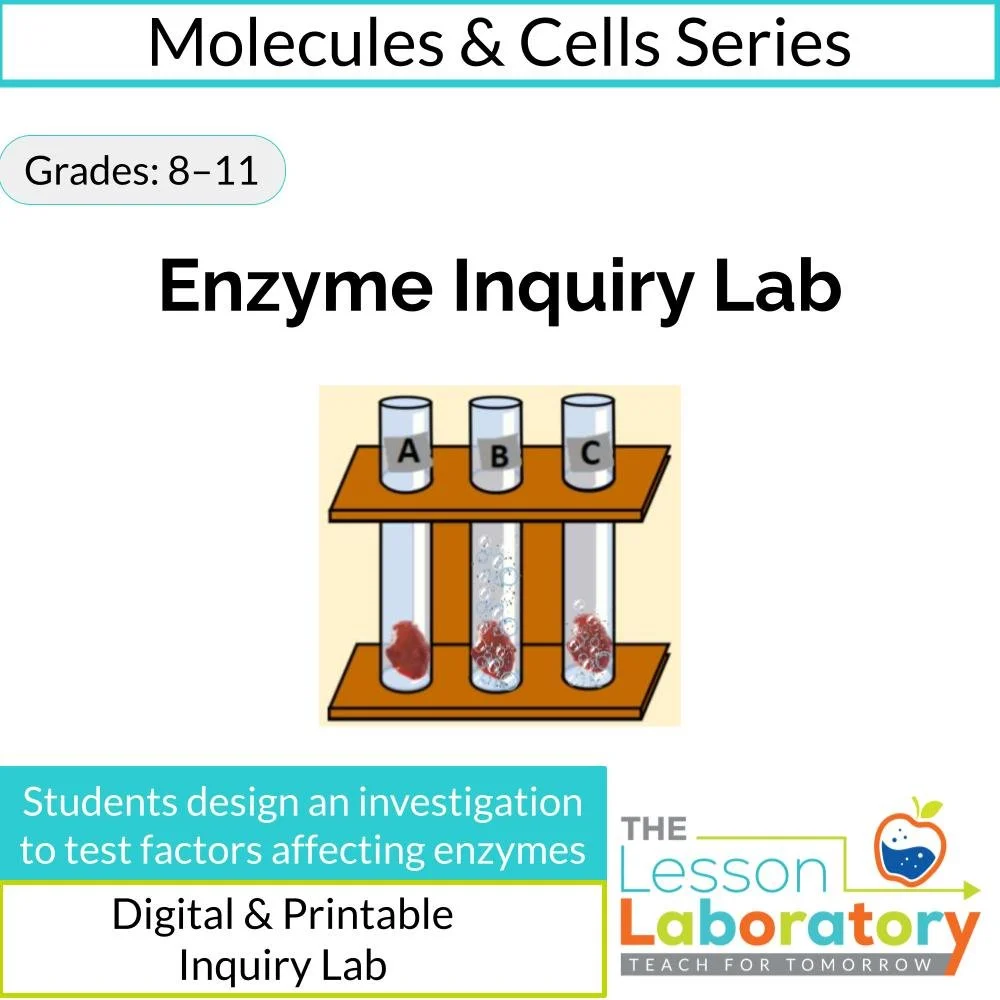
Students design and conduct an investigation on enzyme activity.
This resource is a student-designed inquiry lab on enzyme activity, intended as a culminating investigation for a biomolecules or proteins unit. Students plan and conduct their own experiment to test how environmental factors affect enzyme-catalyzed reactions.
Rather than following a fixed procedure, students choose a research question (such as the effect of temperature or pH), request materials, and design a method for collecting data. They then analyze their results and write a formal lab report, including hypothesis, variables, data tables, graphs, and conclusions.
Two complete formats are included:
In-person lab version:
Students use real materials (such as pineapple, jello, hydrogen peroxide, or liver tissue) to investigate enzymes such as bromelain, catalase, or amylase. A structured planning section guides students through experimental design, variable control, and safety considerations. A materials request form is included so students must justify what they need for their investigation.
Digital interactive version:
For classrooms that cannot run the wet lab, or for students who need an alternate format, a digital version simulates six of the most common enzyme investigations. Students manipulate variables and observe realistic outcomes based on how enzymes respond to temperature and pH. This version supports the same experimental design and analysis goals as the in-person lab.
Teacher supports are built in. The resource includes:
A teacher “grocery list” of possible materials
Explanations of the most commonly designed investigations (answer key)
Student lab planning pages
Formal lab report structure
Printable paper version and digital version
This lab is designed to assess students’ understanding of:
Enzyme function as proteins
Factors that affect reaction rate
Experimental design and variable control
Data interpretation and scientific explanation
It works well as a summative investigation at the end of a biomolecules or enzymes unit and is appropriate for middle and high school biology.
To see a preview of the digital version of this lab, click here.
NGSS Alignment (High School):
HS-LS1-1
Science & Engineering Practices (SEPs):
Planning and Carrying Out Investigations; Analyzing and Interpreting Data; Constructing Explanations
Crosscutting Concepts (CCCs):
Structure and Function; Cause and Effect; Stability and Change
Common Core (Literacy in Science):
RST.9-10.3
RST.9-10.7
WHST.9-10.2
Bundle Upgrade Policy
This lesson is included in one or more bundles. To support flexible purchasing and long-term use of our curriculum, Lesson Laboratory offers a bundle upgrade policy.
If you purchase this lesson and decide at a later date that you would like to upgrade to a bundle, you may request a store credit equal to the total amount paid for duplicate items.
To request an upgrade credit, please email thelessonlaboratory@gmail.com and include:
Your username
The order numbers for both the original purchase(s) and the bundle
The names of the duplicate resources
Requests must be submitted within 30 days of the bundle purchase. Credits are issued as store credit for future Lesson Laboratory purchases and are not provided as cash refunds.
This policy applies only to purchases of resources that are later included in a Lesson Laboratory bundle and is limited to one adjustment per upgrade pathway.
Students design and conduct an investigation on enzyme activity.
This resource is a student-designed inquiry lab on enzyme activity, intended as a culminating investigation for a biomolecules or proteins unit. Students plan and conduct their own experiment to test how environmental factors affect enzyme-catalyzed reactions.
Rather than following a fixed procedure, students choose a research question (such as the effect of temperature or pH), request materials, and design a method for collecting data. They then analyze their results and write a formal lab report, including hypothesis, variables, data tables, graphs, and conclusions.
Two complete formats are included:
In-person lab version:
Students use real materials (such as pineapple, jello, hydrogen peroxide, or liver tissue) to investigate enzymes such as bromelain, catalase, or amylase. A structured planning section guides students through experimental design, variable control, and safety considerations. A materials request form is included so students must justify what they need for their investigation.
Digital interactive version:
For classrooms that cannot run the wet lab, or for students who need an alternate format, a digital version simulates six of the most common enzyme investigations. Students manipulate variables and observe realistic outcomes based on how enzymes respond to temperature and pH. This version supports the same experimental design and analysis goals as the in-person lab.
Teacher supports are built in. The resource includes:
A teacher “grocery list” of possible materials
Explanations of the most commonly designed investigations (answer key)
Student lab planning pages
Formal lab report structure
Printable paper version and digital version
This lab is designed to assess students’ understanding of:
Enzyme function as proteins
Factors that affect reaction rate
Experimental design and variable control
Data interpretation and scientific explanation
It works well as a summative investigation at the end of a biomolecules or enzymes unit and is appropriate for middle and high school biology.
To see a preview of the digital version of this lab, click here.
NGSS Alignment (High School):
HS-LS1-1
Science & Engineering Practices (SEPs):
Planning and Carrying Out Investigations; Analyzing and Interpreting Data; Constructing Explanations
Crosscutting Concepts (CCCs):
Structure and Function; Cause and Effect; Stability and Change
Common Core (Literacy in Science):
RST.9-10.3
RST.9-10.7
WHST.9-10.2
Bundle Upgrade Policy
This lesson is included in one or more bundles. To support flexible purchasing and long-term use of our curriculum, Lesson Laboratory offers a bundle upgrade policy.
If you purchase this lesson and decide at a later date that you would like to upgrade to a bundle, you may request a store credit equal to the total amount paid for duplicate items.
To request an upgrade credit, please email thelessonlaboratory@gmail.com and include:
Your username
The order numbers for both the original purchase(s) and the bundle
The names of the duplicate resources
Requests must be submitted within 30 days of the bundle purchase. Credits are issued as store credit for future Lesson Laboratory purchases and are not provided as cash refunds.
This policy applies only to purchases of resources that are later included in a Lesson Laboratory bundle and is limited to one adjustment per upgrade pathway.